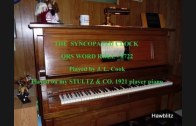
THE SYNCOPATED CLOCK – PIANO ROLL
QRS WORD ROLL- 8722
Written by Leroy Anderson
June 29, 1908 – May 18, 1975
Played by J. Lawrence Cook
Anderson wrote “The Syncopated Clock” in 1945 while
serving with the U.S. Army and assigned as Chief of
the Scandinavian Desk of Military Intelligence in
Washington.
When “The Syncopated Clock” was recorded in 1950, it
was noticed by the producers of a new WCBS-TV program
called The Late Show, a nightly program with a format
of old movies that was to be the station’s first
venture into late night television. The piece was
chosen as the theme music for The Late Show and that
helped publicize Anderson’s music. The “Syncopated
Clock” was used by the show for the next 25 years,
and became a piece that many Americans could readily
hum or whistle, even if few would have known the name
of its composer.
Leroy Anderson also wrote many of my favorites that I first heard as a little girl in the early 50’s……Alma Mater (1954)
Chapel Bells
Freshman on Main Street
Library Reading Room
Class Reunion
Arietta (1962)
Balladette (1962)
Belle of the Ball (1951)
Birthday Party (1970)
Blue Tango (1951)
Bugler’s Holiday (1954)
Cambridge Centennial March of Industry (1946)
(written for organ)
Captains and the Kings, The (1962)
Chatterbox (1966)
Chicken Reel (1946)
China Doll (1951)
Christmas Festival, A (1950) (original version was
9:00, later shortened in 1952 to 5:45)
Clarinet Candy (1962)
Classical Jukebox (1950)
Concerto in C Major for Piano and Orchestra (1953)
(withdrawn by the composer, and released
posthumously)
Cowboy and His Horse, The (1966)
Do You Think That Love Is Here To Stay? (1935)
Easter Song (194-) (written for organ)
Fiddle-Faddle (1947)
First Day of Spring, The (1954)
Forgotten Dreams (1954)
Girl in Satin, The (1953)
Golden Years, The (1962)
Goldilocks (musical) (1958) (some numbers in the
Suite did not appear in the original musical, and
some numbers from the musical are not in this Suite)
Overture (1958)
Come to Me (1958)
Guess Who (1958)
Heart of Stone (Pyramid Dance) (1958)
He’ll Never Stray (1958)
Hello (1958)
If I Can’t Take it With Me (1958)
I Never Know When to Say When (1958)
Lady in Waiting (1958)
Lazy Moon (1958)
Little Girls (1958)
My Last Spring (1958)
Save a Kiss (1958)
Shall I Take My Heart and Go? (1958)
Tag-a-long Kid (1958)
The Pussy Foot (1958)
Town House Maxixe (1958)
Who’s Been Sitting in My Chair ? (1958)
Governor Bradford March (1948) (published
posthumously)
Harvard Fantasy (1936)
Harvard Festival, A (1969)
Hens and Chickens (1966)
Home Stretch (1962)
Horse and Buggy (1951)
Irish Suite (1947 & 1949)
The Irish Washerwoman (1947)
The Minstrel Boy (1947)
The Rakes of Mallow (1947)
The Wearing of the Green (1949)
The Last Rose of Summer (1947)
The Girl I Left Behind Me (1949)
Jazz Legato (1938)
Jazz Pizzicato (1938)
Love May Come and Love May Go (1935)
Lullaby of the Drums (1970) (published posthumously)
March of the Two Left Feet (1970)
Melody on Two Notes (~1965)
Mother’s Whistler (1940) (published posthumously)
Music in My Heart, The (1935)
Old Fashioned Song, An (196-)
Penny Whistle Song, The (1951)
Phantom Regiment, The (1951)
Piece for Rolf (1961)
Pirate Dance (1962) (optional SATB chorus)
Plink, Plank, Plunk! (1951)
Promenade (1945)
Pussy Foot Ballet Music, The (1962)
Sandpaper Ballet (1954)
Saraband (1948)
Scottish Suite (1954)
The Bluebells of Scotland
Turn Ye To Me
Second Regiment Connecticut National Guard March
(1973)
Serenata (1947)
Sleigh Ride (1948)
Song of Jupiter (1951)
Song of the Bells (1953)
Suite of Carols for Brass (1955) (seven carols)
Suite of Carols for Strings (1955) (six carols)
Suite of Carols for Woodwinds (1955) (six carols)
Summer Skies (1953)
Syncopated Clock, The (1945)
Ticonderoga March (1939) (Anderson’s only work
written for concert band)
To a Wild Rose (1970) (arranged from the song by
Edward MacDowell) (published posthumously)
Trumpeter’s Lullaby, A (1949)
Typewriter, The (1950)
Waltz Around the Scale (1970)
Waltzing Cat, The (1950)
Wedding March for Jane and Peter (1972)
What’s the Use of Love? (1935)
Whistling Kettle, The (~1965)
Woodbury Fanfare (1959) (for four trumpets)
You Can Always Tell a Harvard Man (1962)
source